At our Seoul skin clinic in Myeongdong, patients who have had Potenza often ask afterwards why a particular tip was selected, and whether a different one would have suited their skin better.
At our English-speaking skin clinic in Myeongdong, Seoul, many individuals visit with concerns related to enlarged pores, acne scars, skin texture, fine lines, and reduced elasticity. In many of these cases, Potenza is one of the treatments frequently considered during consultation.
Hello, I’m Dr. Youjoo Hwang, Chief Director of LIJIN Clinic.
While many people recognize Potenza simply as a “microneedling RF treatment,” one of the most important factors influencing treatment direction and outcome is actually the tip selection process.
Today, I’d like to explain how Potenza works, how invasive RF tips differ from one another, and why choosing the appropriate tip can significantly influence treatment approach and skin response.
What Is Potenza?
Potenza is an RF microneedling device that delivers radiofrequency energy into the dermis through fine microneedles.
Rather than focusing only on the skin surface, the treatment is designed to deliver energy into deeper dermal layers where collagen remodeling occurs.
Because of this mechanism, Potenza is often discussed for concerns related to:
- enlarged pores
- acne scars
- fine lines
- skin texture
- elasticity loss
- overall skin quality
One of Potenza’s major strengths is its ability to utilize multiple tip types and customizable settings depending on individual skin condition and treatment goals.
For this reason, tip selection becomes extremely important during treatment planning.
Different tips influence:
- energy depth
- heat distribution
- treatment intensity
- skin response
- downtime profile
Because of this, selecting the appropriate tip according to skin condition and treatment objective is an important part of personalized treatment design.
How Invasive RF Tips Work
Invasive RF tips utilize fine needles that penetrate through the epidermis into the dermis before releasing radiofrequency energy within the skin.
Rather than delivering energy only to the surface, this structure allows RF energy to interact more directly with dermal collagen-related layers.
Because of this mechanism, invasive RF approaches are often associated with:
- collagen remodeling
- acne scar improvement
- pore refinement
- elasticity support
- skin texture improvement
At LIJIN Clinic, several invasive Potenza tip types are commonly selected depending on individual skin condition and treatment goals.
Non-Insulated RF Tips (N Tips)
Non-insulated tips release energy along the full length of the needle.
Because energy distribution occurs more broadly within the tissue, stimulation intensity tends to be relatively stronger compared to insulated tips.
Common non-insulated tip types include:
- N16
- N25
- N49
At LIJIN Clinic, N25 or N49 are commonly selected depending on acne scar severity, pore size, and overall skin condition.
Because RF energy spreads laterally from the needle surface, non-insulated tips are often considered for:
- deeper acne scars
- enlarged pores
- thicker skin texture
- stronger collagen remodeling approaches
Following treatment, temporary redness, swelling, warmth, or more visible pores may appear for several days as part of the regeneration process.
Insulated RF Tips (I Tips)
Insulated tips are designed so that RF energy is released primarily at the needle tip rather than along the entire needle body.
Because of this structure, epidermal surface impact may be reduced while energy is delivered more selectively into deeper layers.
Common insulated tip types include:
- I16
- I25
- I49
At LIJIN Clinic, I25 is frequently considered for concerns such as:
- overall pore refinement
- fine lines
- skin texture
- elasticity support
- smoother skin quality
Because insulated tips may reduce surface irritation, they are sometimes considered for thinner or more sensitive skin types as well.
Downtime is often relatively shorter compared to stronger non-insulated approaches.
Common Effects Associated With Potenza Pore Tips
Potenza invasive RF tips are commonly discussed in relation to:
- collagen remodeling support
- pore refinement
- skin elasticity improvement
- fine line improvement
- smoother skin texture
- sebaceous activity reduction
However, treatment response may vary depending on individual skin condition and treatment settings.
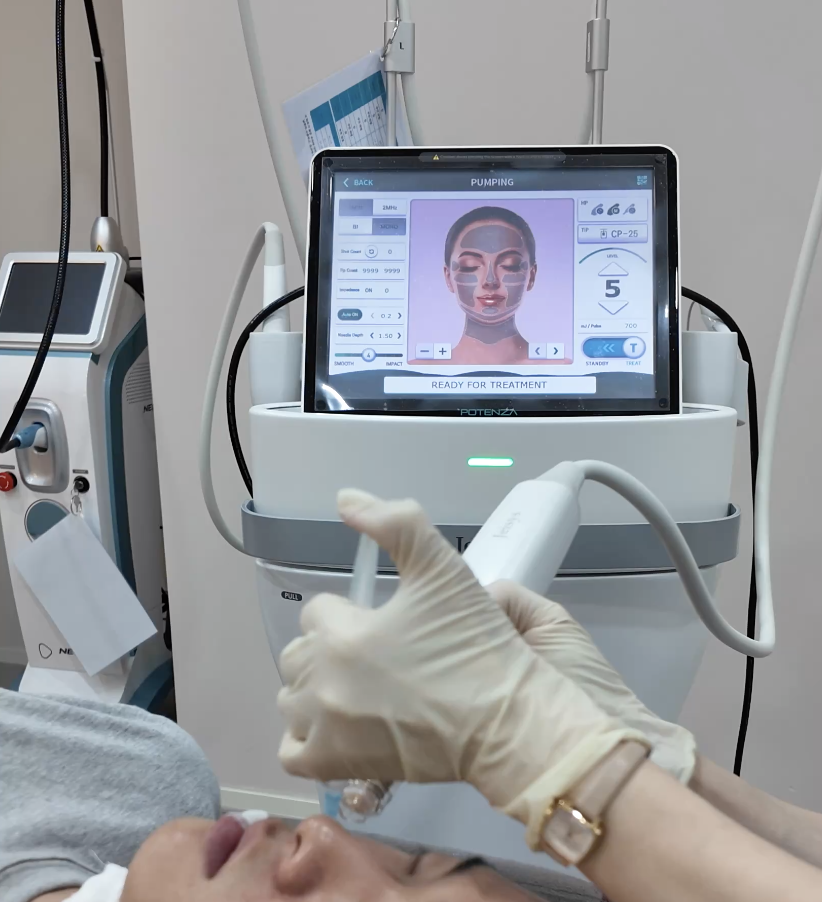
What Is the Potenza Pumping Tip?
The pumping tip works differently from traditional invasive RF tips.
Rather than focusing mainly on RF stimulation itself, the pumping tip creates microchannels within the skin while utilizing vacuum-assisted delivery to help skin booster absorption.
Because of this structure, pumping tips are frequently combined with treatments such as:
This approach is often considered for individuals seeking:
- hydration improvement
- glow enhancement
- barrier support
- skin recovery support
- smoother skin texture
For individuals uncomfortable with traditional injection-based skin boosters, pumping-tip delivery may sometimes be discussed as an alternative approach.
Potenza Treatment Is About More Than Just the Tip
Potenza treatment planning involves far more than simply selecting a tip type.
Other important factors include:
- needle depth
- RF intensity
- monopolar or bipolar mode
- MHz settings
- shot count
- treatment intervals
Even when the same device is used, outcomes may vary significantly depending on treatment design, skin condition, and individual settings.
Because of this, consultation and skin analysis before treatment are extremely important.
Personalized Potenza Consultation at LIJIN
At LIJIN Clinic in Myeongdong, Potenza treatment plans are personalized according to:
- skin thickness
- acne scar type
- pore condition
- elasticity level
- skin sensitivity
- downtime preference
- overall treatment goals
Rather than applying identical settings to every individual, treatment direction is adjusted according to current skin condition and desired outcome.
Potenza is not simply a one-dimensional RF microneedling procedure.
Tip selection, energy settings, depth, RF mode, and individualized treatment planning all influence how the skin responds over time.
At our premium English-speaking skin clinic in Myeongdong, Seoul, consultations are personalized based on each individual’s skin condition and treatment goals.
Thank you for reading.
This was Dr. Youjoo Hwang, Chief Director of LIJIN Clinic.
WhatsappReady to book your treatment? English-speaking staff, open every day including Sundays, 9:30 AM–8:00 PM.